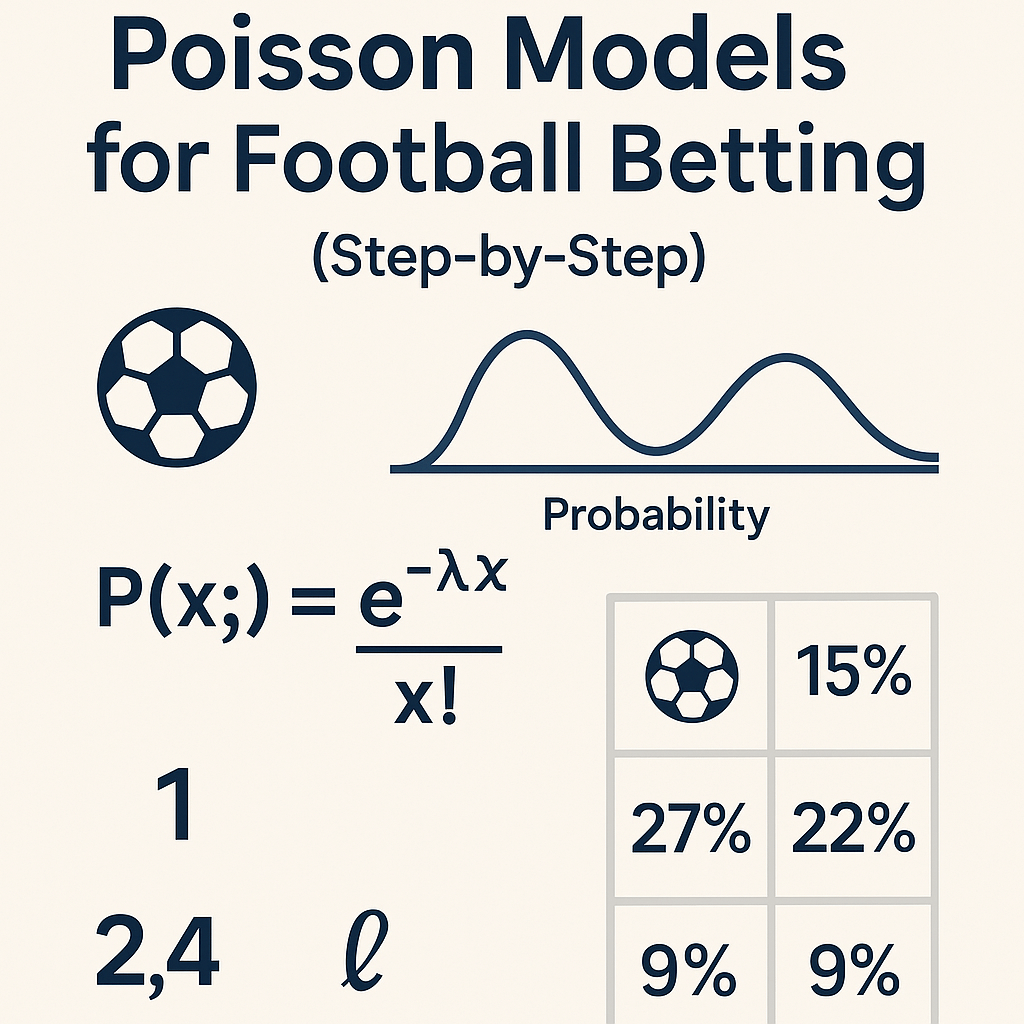
Mathematics has quietly powered professional sports betting for decades — and one of the most famous models is the Poisson distribution.
In football, Poisson models are used to predict how many goals each team might score, helping you calculate probabilities for outcomes like Over/Under, Correct Score, and Both Teams to Score.
This guide explains exactly how the Poisson model works, how to build one step-by-step, and how to apply it to your football betting — without needing a degree in statistics.
💡 Tip: Use our free Poisson Calculator for Football Scores to generate goal probabilities automatically.
The Poisson distribution is a probability model that estimates how often an event occurs within a fixed interval — like goals in a football match.
It assumes events (goals) happen independently and at a known average rate (λ, lambda).
In simple terms:
If you know how many goals a team scores on average, you can use Poisson to estimate how likely they are to score 0, 1, 2, 3… goals in a given match.
P(x;λ)=e−λλxx!P(x; λ) = \frac{e^{-λ} λ^x}{x!}P(x;λ)=x!e−λλx
Where:
You’ll need at least one season’s worth of results to build averages.
| Data Needed | Description |
|---|---|
| Goals scored at home | Team’s offensive strength |
| Goals conceded at home | Team’s defensive weakness |
| Goals scored away | Team’s attack rating on the road |
| Goals conceded away | Team’s defensive rating on the road |
Example (per match averages from Premier League 2023–24):
For each team: Attack Strength=Team’s Avg Goals ScoredLeague Avg Goals (Home or Away)\text{Attack Strength} = \frac{\text{Team’s Avg Goals Scored}}{\text{League Avg Goals (Home or Away)}}Attack Strength=League Avg Goals (Home or Away)Team’s Avg Goals Scored Defence Strength=Team’s Avg Goals ConcededLeague Avg Goals (Home or Away)\text{Defence Strength} = \frac{\text{Team’s Avg Goals Conceded}}{\text{League Avg Goals (Home or Away)}}Defence Strength=League Avg Goals (Home or Away)Team’s Avg Goals Conceded
Example:
For the home team: λhome=Home Attack Strength×Away Defence Strength×League Avg Home Goalsλ_{home} = \text{Home Attack Strength} × \text{Away Defence Strength} × \text{League Avg Home Goals}λhome=Home Attack Strength×Away Defence Strength×League Avg Home Goals
For the away team: λaway=Away Attack Strength×Home Defence Strength×League Avg Away Goalsλ_{away} = \text{Away Attack Strength} × \text{Home Defence Strength} × \text{League Avg Away Goals}λaway=Away Attack Strength×Home Defence Strength×League Avg Away Goals
Continuing the Arsenal v Spurs example:
So our expected goals (λ):
Now apply the Poisson formula to find the probability of each team scoring 0–5 goals.
| Goals (x) | Arsenal (λ = 2.18) | Spurs (λ = 1.24) |
|---|---|---|
| 0 | 0.113 | 0.289 |
| 1 | 0.247 | 0.358 |
| 2 | 0.269 | 0.222 |
| 3 | 0.195 | 0.092 |
| 4+ | 0.176 | 0.039 |
These probabilities should sum close to 1.00 (100%).
🧮 Use our Poisson Calculator to get these instantly for any teams.
Now multiply team probabilities to get joint match outcomes.
| Arsenal ↓ / Spurs → | 0 | 1 | 2 | 3 | 4 |
|---|---|---|---|---|---|
| 0 | 3.3% | 4.1% | 2.5% | 1.0% | 0.4% |
| 1 | 7.4% | 9.0% | 5.5% | 2.2% | 0.9% |
| 2 | 8.0% | 9.7% | 5.9% | 2.4% | 1.0% |
| 3 | 5.8% | 7.1% | 4.3% | 1.8% | 0.7% |
| 4 | 3.3% | 4.1% | 2.5% | 1.0% | 0.4% |
Sum the diagonal cells (0-0, 1-1, 2-2…) for draw probability.
Sum the upper and lower triangles for home and away win probabilities.
Fair Odds=1Probability\text{Fair Odds} = \frac{1}{\text{Probability}}Fair Odds=Probability1
Example:
If Arsenal win probability = 55%,
→ Fair odds = 1 ÷ 0.55 = 1.82
Compare that with bookmaker odds to identify value bets.
🎯 For value detection, use the Expected Value Calculator.
Add up goal combinations:
Example:
Compare with market prices to see if a bet is mathematically justified.
The Poisson model is simple but powerful. Its accuracy depends on good data.
You can refine it by:
⚙️ Advanced bettors combine Poisson with expected goals (xG) data for more realistic forecasts.
Still, as a baseline, it beats guessing — and it’s transparent and reproducible.
Bookmakers also use Poisson-based frameworks (plus proprietary data layers) to price markets, especially for football, tennis, and baseball.
By understanding their approach, you’re effectively reading their pricing language — and can identify when odds diverge from real probabilities.
Let’s say Manchester City host Aston Villa:
Compute probabilities:
If a bookmaker offers City at 1.55, that’s slightly longer than your model’s 1.39 — potential value.
Use the model to:
→ Read next: Bankroll Management for Bettors
→ See also: Value Betting Strategies
| Step | Action | Tool |
|---|---|---|
| 1 | Gather team goal data | Results/Stats feed |
| 2 | Calculate attack & defence strengths | Spreadsheet |
| 3 | Estimate expected goals (λ) | Formula |
| 4 | Apply Poisson distribution | Poisson Calculator |
| 5 | Combine outcomes | Matrix table |
| 6 | Convert to odds | EV Calculator |
| 7 | Compare with bookmaker prices | Odds comparison sites |
The Poisson distribution is a mathematical model that estimates the probability of a team scoring a certain number of goals in a match, based on their average scoring rate.
Expected goals (λ) are calculated using team attack and defence strengths multiplied by the league average goals per match. The Poisson formula then gives probabilities for 0, 1, 2, 3+ goals.
Poisson models predict probabilities for match outcomes like Correct Score, Over/Under, and Both Teams to Score. They’re most accurate for typical goal ranges (0–4).
They’re reliable as a baseline but limited by assumptions. Poisson ignores situational factors like form, red cards, and tactics, so results should be used alongside judgement or xG models.
You can use the free Poisson Calculator on Bets For Today to calculate goal probabilities, match outcomes, and Over/Under odds from expected goals values.