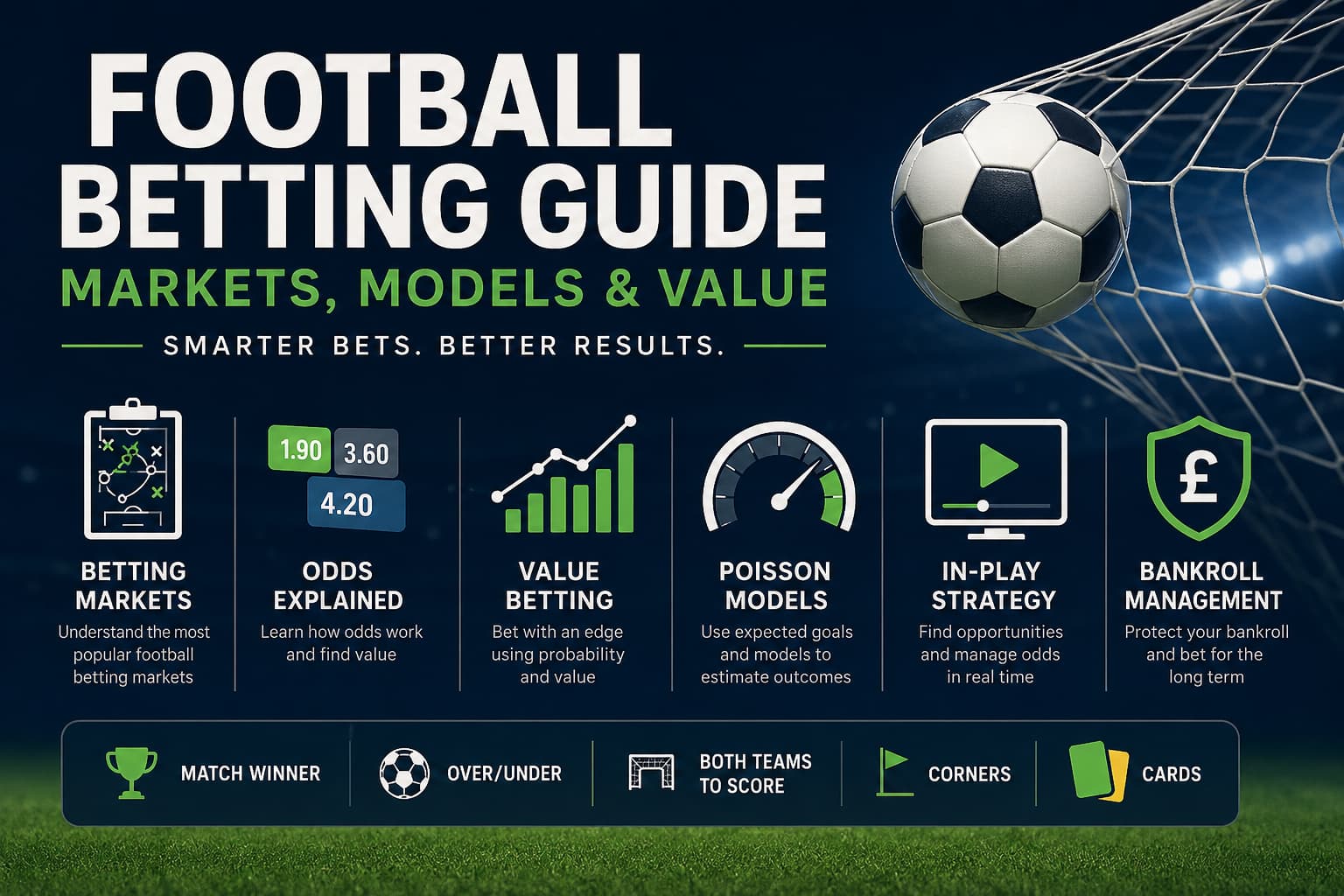
Football betting is the most popular form of sports betting in the UK. Every weekend, millions of punters look at Premier League, EFL, Champions League and international fixtures and try to answer the same question: where is the value?
This football betting guide explains how to approach the sport properly. We’ll cover the main football betting markets, how odds work, what “value” means, how expected goals and Poisson models can help, and why bankroll management matters more than chasing tips.
Whether you are completely new to football betting or want to improve your approach, this guide will help you understand the markets and make more informed decisions.
For the basics, you may also want to read our Beginner’s Guide to Sports Betting in the UK and Odds Explained Guide.
Football is ideal for betting because it is familiar, data-rich and available almost every day of the week. UK bettors can choose from domestic leagues, European competitions, international tournaments, women’s football, youth matches and lower-league fixtures.
Football also offers a huge range of betting markets. You can bet on the match result, total goals, both teams to score, cards, corners, player shots, correct score, handicaps, outright winners and much more.
That variety is useful, but it can also be overwhelming. The key is not to bet on everything. The key is to specialise, understand the markets you use, and only place a bet when the odds look bigger than the true probability.
At its simplest, football betting means placing money on a football outcome.
Examples include:
Most standard football bets are settled on the result after 90 minutes plus stoppage time, unless the bookmaker clearly states otherwise. Extra time and penalties usually only count in specific qualification or outright markets.
Always check the market rules before placing a bet, especially in cup competitions.
Football odds show two things:
For example, decimal odds of 2.00 imply a 50% chance.
The formula is:
Implied probability = 1 ÷ decimal odds
So:
If you think an outcome is more likely than the odds suggest, you may have found a value bet.
For a full explanation, read Odds Explained: Fractional, Decimal & American and try the Odds Converter Calculator.
Football betting markets can be grouped into several categories: result markets, goals markets, handicap markets, player markets, stats markets and outright markets.
Let’s break down the key ones.
The classic football betting market is the match result, often shown as 1X2.
Example:
| Outcome | Odds |
|---|---|
| Arsenal win | 1.90 |
| Draw | 3.60 |
| Tottenham win | 4.20 |
This is the simplest football market, but not always the easiest to beat. Bookmakers price major match result markets very efficiently, especially in top leagues.
Match result betting is best when you have a strong opinion that the market has underestimated a team’s chance.
Double chance lets you cover two of the three possible outcomes.
The options are:
Double chance markets reduce risk but also reduce odds.
For example, if you like an underdog but worry they may only draw, X2 can be useful. However, because the price is shorter, you still need to check whether it offers value.
Draw No Bet, or DNB, removes the draw as a losing result.
If your team wins, your bet wins. If the match is drawn, your stake is returned. If your team loses, your bet loses.
This can be useful when you expect one side to be stronger but want protection against a low-scoring draw.
Example:
DNB is often a cleaner alternative to double chance because it is easier to understand and model.
Over/Under is one of the most popular football betting markets.
The most common line is Over/Under 2.5 Goals.
Other common lines include:
This market is useful because you do not need to predict the winner. You only need to predict the likely goal environment.
Things to consider:
For a data-led approach, read our Poisson Models for Football Betting guide.
Both Teams to Score, often shortened to BTTS, is a simple yes/no market.
BTTS is popular because it matches how many fans watch football: “Will both sides create chances?”
Useful factors include:
BTTS can be especially interesting when both teams are attack-minded but defensively vulnerable.
Correct score betting asks you to predict the exact final score.
Examples:
Correct score markets offer bigger odds, but they are high variance. Even if your read on the match is generally right, one late goal can turn a winning bet into a loser.
Beginners should treat correct score bets carefully. They are better used when you have a clear model-based view of goal probabilities rather than as guesswork.
Poisson models can help estimate correct score probabilities by assigning expected goals to each team and generating a score matrix.
Asian Handicap betting gives one team a virtual goal advantage or disadvantage. It reduces or removes the draw and can offer more precise pricing than standard match result markets.
Examples:
Quarter lines such as +0.25 or -0.75 split your stake across two handicap lines.
Asian Handicaps are popular with more experienced bettors because they allow you to fine-tune risk.
Corners markets focus on the number of corners in a match, team corners or corner handicaps.
Common markets include:
Corners betting requires different analysis from goals betting. You need to consider:
A team that dominates possession may not always win the corner count if it attacks centrally. Equally, an underdog that spends the second half chasing may produce a flurry of late corners.
Cards markets are based on yellow and red cards.
Common markets include:
Cards betting depends on:
Do not rely only on “big game” narratives. A derby may be intense, but the referee and tactical setup can be just as important.
Player markets have grown significantly in recent years.
Popular options include:
Player markets can offer value, but they require careful team news analysis. A player who is not starting will usually void or lose depending on the bookmaker’s rules, so always check line-ups before betting.
For shots markets, consider:
A striker with high shot volume against a deep defensive block may have a very different profile from the same striker in a match where his team is likely to counterattack.
Bet builders allow you to combine multiple selections from the same match.
Example:
Bet builders are fun and popular, but they can be poor value if used carelessly. The more legs you add, the harder the bet becomes. Some outcomes are correlated, but bookmaker pricing may not always be generous.
Use bet builders sparingly and make sure every leg has a reason.
Outright markets focus on longer-term outcomes.
Examples include:
Outright betting ties up your bankroll for longer. That means you need to consider not just probability but opportunity cost.
Before placing an outright bet, ask:
The most important concept in football betting is value.
A value bet is not simply a bet you think will win. It is a bet where the odds are bigger than the true probability.
Example:
You think Brighton have a 50% chance of winning. Fair odds would be 2.00.
If a bookmaker offers 2.30, the price may represent value.
If a bookmaker offers 1.75, Brighton may still win, but the bet is probably poor value.
This is why good football bettors think in probabilities, not certainties.
Use the Expected Value Calculator to compare your estimated probability with the bookmaker’s odds.
Expected goals, or xG, estimates the quality of chances created and conceded.
A shot from two yards out has a higher xG than a long-range shot from 30 yards. By adding up chance quality, xG can give a better picture of performance than the final score alone.
xG is useful because football results are noisy. A team can win 2-0 despite creating poor chances. Another team can lose 1-0 despite dominating the match.
Football bettors use xG to assess:
However, xG is not a magic answer. It should be used alongside team news, tactics, schedule, motivation and market price.
Poisson models are a popular way to estimate football score probabilities.
The basic idea is to estimate each team’s expected goals, then use a probability model to calculate scorelines such as 0-0, 1-0, 1-1, 2-1 and so on.
Poisson models can help with:
For a full step-by-step explanation, read Poisson Models for Football Betting.
A simple example:
From those numbers, you can estimate the probability of each team scoring 0, 1, 2, 3 or more goals, then combine those probabilities into a score matrix.
The model will not be perfect, but it gives you a structured baseline rather than relying on instinct.
Football is one of the most popular sports for in-play betting. Odds move constantly based on goals, red cards, injuries, substitutions, pressure and time remaining.
In-play opportunities can appear when the market overreacts to events.
Examples:
However, in-play betting is also dangerous because decisions happen quickly. You need a plan before the match starts.
Read In-Play Betting: Strategy, Timing & Cash-Out before betting live.
Cash-out lets you settle a bet early for a profit or loss based on the current odds.
It can be useful, but it is not always good value. The bookmaker usually builds a margin into the cash-out offer.
Cash-out may make sense when:
Cash-out is less useful when it is driven purely by fear.
Before accepting cash-out, ask: “Would I place the opposite bet at this price?” If not, the offer may not be good value.
Football betting involves variance. Even strong value bets lose. A red card, penalty miss or deflected goal can ruin good analysis.
That is why bankroll management is essential.
A sensible approach:
Many bettors use 1–2% of bankroll per bet as a conservative starting point. More advanced bettors may use Kelly staking, but only if they can estimate probabilities accurately.
Read the full Bankroll Management Guide and try the Kelly Criterion Calculator.
Avoid these common beginner mistakes:
The biggest mistake is confusing likely winners with good bets. A team can be likely to win but still be bad value if the price is too short.
A structured routine can improve your decision-making.
Start with a few leagues you know well. It is better to understand the Premier League, Championship and Champions League deeply than to bet randomly across 20 leagues.
Look beyond league position. Review:
Before looking at odds, estimate the chance of the outcome yourself. Then compare your price to the bookmaker’s price.
Track:
This helps you see which markets you actually understand.
After enough bets, review your performance by category:
You may discover that your edge is strongest in one or two specific markets.
These tools support more disciplined betting:
Football is emotional. Big matches, live TV, rivalries and social pressure can all encourage impulsive betting.
Stay in control by:
Helpful resources include:
Only bet what you can afford to lose.
| Area | Key Point |
|---|---|
| Best beginner market | Match result or Over/Under |
| Best data-led markets | Goals, BTTS, player shots, corners |
| High-risk markets | Correct score, large accumulators, complex bet builders |
| Useful model | Poisson expected goals model |
| Key concept | Value, not certainty |
| Best habit | Track every bet |
| Biggest risk | Emotional in-play betting |
| Essential support | Bankroll management |
Football betting is easy to start but difficult to master. The best bettors do not simply predict winners. They compare probability with price.
Start with simple markets, learn how odds work, build a staking plan, and focus on finding value. As your confidence grows, you can explore expected goals, Poisson models, player props, corners, cards and in-play angles.
Most importantly, avoid betting for the sake of it. A good football bet needs three things: a clear reason, a fair price, and a sensible stake.
For your next step, read:
How to Read Popular Betting Markets
Odds Explained: Fractional, Decimal & American
Poisson Models for Football Betting
Bankroll Management for Bettors
Football betting means placing bets on football outcomes such as match result, goals, both teams to score, corners, cards, player shots, correct score or outright winners.
The most popular football betting markets include match result, Over/Under goals, Both Teams to Score, Draw No Bet, Asian Handicap, correct score, corners, cards and player markets.
Value betting in football means finding odds that are higher than the true probability of an outcome. A bet can be good value even if it loses, and poor value even if it wins.
Poisson models can be useful for estimating football score probabilities, especially for Over/Under goals, Both Teams to Score and correct score markets. They should be used as a baseline alongside team news, tactics and market prices.
Beginners should start with simple markets such as match result, Over/Under goals and Both Teams to Score. They should also learn odds, bankroll management and value betting before using complex bet builders or in-play strategies.